Ever since we settled in the archipelago, people keep asking us what “travelling responsibly” really means in Guadeloupe. Not the slogan version: the concrete one, the kind that plays out under the shower of a guesthouse, while parking the car in front of a beach, or when choosing where to swim. Sustainable tourism in Guadeloupe isn’t something you declare, it’s something you practise, one habit at a time — and frankly, it makes the trip better. This butterfly-shaped French overseas territory (volcanic, forested Basse-Terre, a UNESCO World Biosphere Reserve, limestone and seaside Grande-Terre, plus the southern islands) lives year-round with its resources and its fragilities: sargassum, pressure on natural sites, water management. Here is our field guide, with precise addresses and realistic figures, for a responsible trip in Guadeloupe without giving up on pleasure.
The packing kit: 5 items that change everything
An eco-friendly stay is prepared before you even board at Pôle Caraïbes airport (Pointe-à-Pitre). Slip these five items into your suitcase and you’ll avoid plenty of useless purchases on site.
- Reef-safe sunscreen: without oxybenzone or octinoxate, those chemical filters that bleach coral. A mineral brand (zinc oxide) costs 12 to 20 € in mainland France, 18 to 28 € locally.
- A UV-protective rash guard (10 to 30 €): it replaces most of the cream on your torso and shoulders. The best sunscreen is still fabric.
- An insulated water bottle: tap water is drinkable across most of the network; you refill, you don’t throw away.
- A foldable shopping bag: single-use plastic bags are banned.
- Water shoes: they protect you from sea urchins and stop you treading on seagrass beds and shallow coral.
Reef-safe sunscreen is not a marketing gimmick here. At spots like Malendure (Bouillante), the gateway to the Cousteau Reserve and its Pigeon Islets, thousands of swimmers pass over the same coral every week: chemical filters build up and accelerate bleaching. The reflex: mineral cream 20 minutes before the water, rash guard on top, zero spray.
Understanding sargassum: a phenomenon to anticipate, not to fear
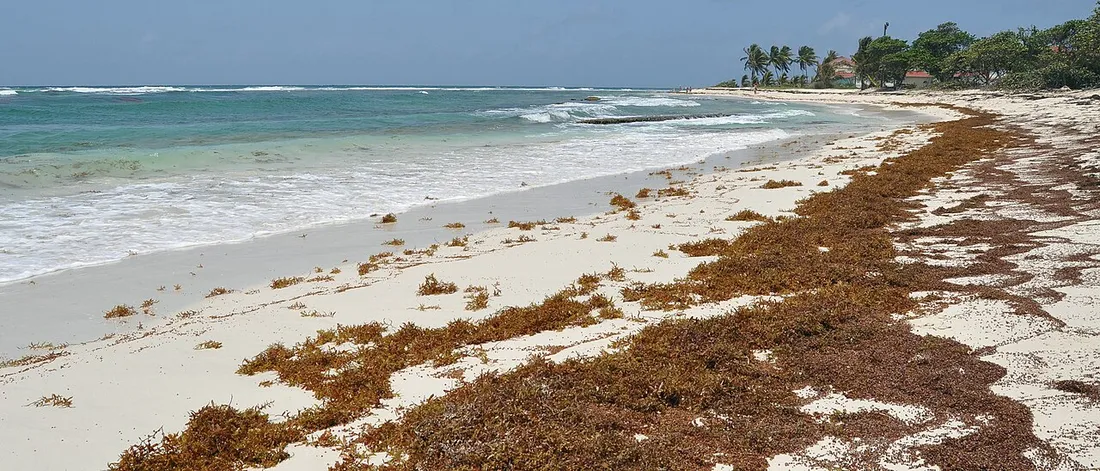
Sargassum are floating brown algae that drift in from the tropical Atlantic and sometimes wash up on the coast. As they decompose on the sand, they release hydrogen sulphide, which smells like rotten eggs, and can make a beach temporarily unwelcoming.
When and where to watch for arrivals
The strandings are seasonal and localised. In Guadeloupe, they mainly affect the windward coast, that is the eastern and south-eastern shoreline, exposed to Atlantic currents:
- Most affected municipalities: Le Moule, Saint-François (east side), Capesterre-Belle-Eau, La Désirade.
- Generally spared municipalities: Deshaies, Bouillante and the entire leeward coast of Basse-Terre, as well as the sheltered beaches of Grande-Terre.
- Most active period: broadly from March to October, with peaks that vary from year to year.
The good news: the dry season, from December to April, which is also the best time to visit the archipelago, coincides with often weaker arrivals. Before booking a beach activity, check the stranding bulletins published by the local authorities and the dedicated forecasting app: the information is free and updated daily.
Coping well with a sargassum episode
A stranding doesn’t ruin a stay if you know how to adapt:
- Favour the leeward coast: Grande Anse in Deshaies, the Cousteau Reserve in Bouillante, or the protected beaches.
- Go for high-altitude sites: la Soufrière (1,467 m), the Carbet Falls, the National Park trails have nothing to do with the algae.
- Avoid touching and lingering near decomposing piles, especially with young children or people with asthma.
Water: Basse-Terre’s most precious resource
This is the point visitors misunderstand. Despite the abundant rain on the heights of Basse-Terre, the network suffers: massive leaks, ageing pipes and water rotations (scheduled cut-offs) that regularly hit entire neighbourhoods, sometimes for several hours a day. Protecting coral and the lagoon also starts at the tap. A few habits that apply in a rental as much as in a hotel:
- Short showers, water off while soaping. For a family of four, the daily saving runs into hundreds of litres.
- Reuse your towels for several days rather than demanding a daily change.
- Report any leak to your host: an untreated leak is water lost for the whole neighbourhood.
- Keep water in reserve in a bottle or a bucket to get through a water rotation without buying plastic packs.
Waste: smart sorting on an island territory
On an island, anything that isn’t sorted ends up buried or exported at great cost. The basic rule is the same as on the mainland, but a few local reflexes make the difference.
- On the beach and on hikes, leave NOTHING. Cigarette butts included: a butt takes years to break down and pollutes the sand and the lagoon. Carry a pocket ashtray.
- Reduce at source: choose the market over over-packaged trays, buy rum and spices loose from the producer, refuse disposable straws and cutlery.
- Glass goes back to the drop-off points found in most municipalities: an empty rum bottle goes in the glass column, not in the villa’s bin.
- Batteries, medicines and small appliances go back to the pharmacy or convenience store, never into nature.
Eating local: producers, markets and lolos (our favourite spots)
Eating local is the most enjoyable eco-habit of the trip: fewer food-miles (a local pineapple hasn’t crossed the Atlantic), a supported local economy and better plates.
Markets and producers
- Sainte-Anne market: every morning, local fruit, colombo spices, vanilla and jams. Expect 2 to 4 € a kilo of seasonal fruit (pineapple, passion fruit, mangoes), 5 to 8 € a bag of spices.
- Saint-Antoine market, Pointe-à-Pitre: a large covered market, ideal for vanilla and infused rums.
- Producers in Vieux-Habitants and along the Route de la Traversée (Basse-Terre): Bonifieur coffee, cocoa, fruit of the day. Buying at the farm means zero middleman and zero over-packaging.
Lolos rather than chains
The lolos are those small Creole restaurants, often right by the beach. In Sainte-Anne, the row of lolos behind the Caravelle beach serves grilled fish, accras and colombo for 12 to 18 € a dish: local cuisine, made by locals, with local produce. Ask where the fish comes from — conch (lambi) and sea urchin are regulated and subject to seasonal closures to protect the species.
Choosing protected sites: the map of preserved areas
Guadeloupe has chosen to safeguard its natural jewels. By heading for these managed areas, travellers reduce their impact while enjoying more authentic experiences.
The Cousteau Reserve (Malendure, Pigeon Islets)
Off Bouillante, the Cousteau Reserve is the number one diving and snorkelling spot in the archipelago. The Pigeon Islets shelter coral, turtles and multicoloured fish accessible right from the surface. Expect around 20 to 30 € for a snorkelling outing by boat, and around 60 to 70 € for a first dive with local clubs that apply the right rules. The golden rule: you look, you don’t touch, and you never feed the fish.
The Guadeloupe National Park
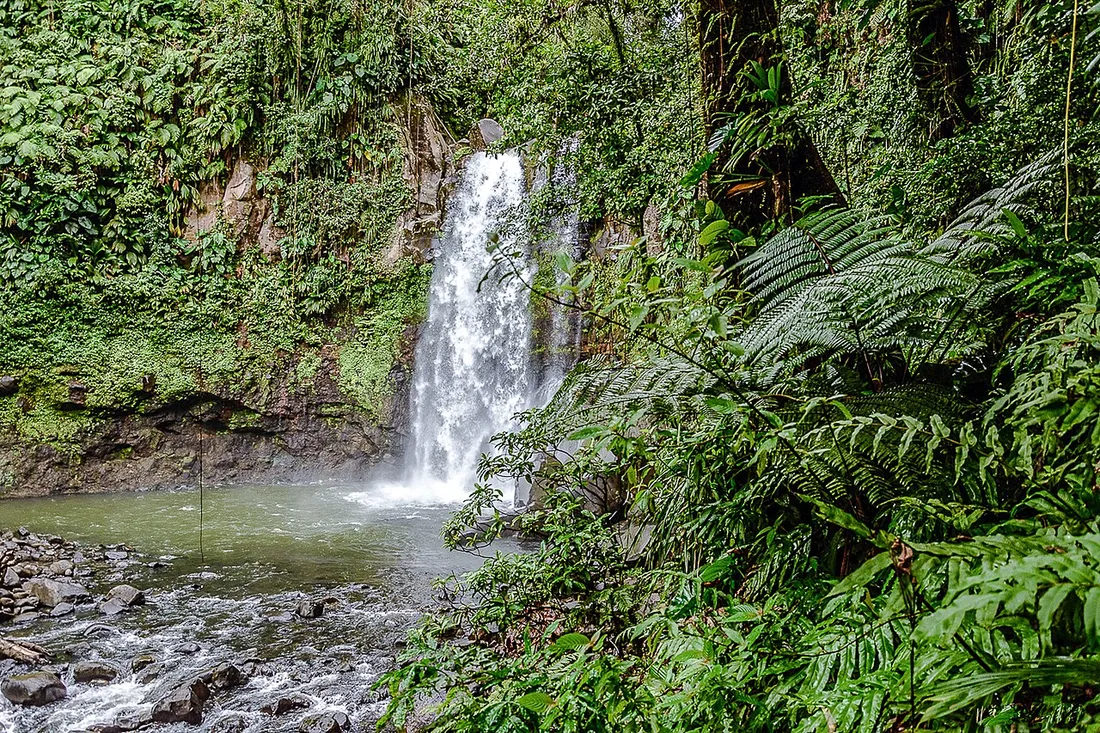
The green heart of Basse-Terre, the National Park protects the tropical forest, the Soufrière massif (1,467 m) and the Carbet Falls. Hiking there responsibly comes down to a few rules, but they are firm:
- Stay on marked trails: going off-path tramples fragile endemic flora.
- Pick nothing, take nothing: flowers, ferns, rocks, everything stays put.
- Bivouacs, fires, drones and dogs are banned in the park’s core.
- Observe wildlife from a distance: green turtles at Malendure or Grande Anse (Deshaies), Lesser Antillean iguanas, endemic birds such as the Guadeloupe woodpecker. You look, you don’t feed, you don’t shine lights on nesting at night.
The smaller islands, ecosystems to handle with care
- Petite-Terre: a classified nature reserve, with a turquoise lagoon and a colony of endemic iguanas. Access is regulated by shuttles (around 65 to 90 € for the day from Saint-François); the number of visitors is deliberately limited.
- Les Saintes (Terre-de-Haut): its bay ranks among the most beautiful in the world. Favour the electric bike or walking over the petrol scooter.
- Marie-Galante and La Désirade: a slow pace, distilleries (Bielle, Bellevue, Père Labat rum) and unspoiled beaches. The island of a hundred mills is best discovered by bike.
Pacing your trips and respecting Creole culture
An often forgotten habit: pacing your trips. The archipelago stretches across two wings and a Grande-Terre / Basse-Terre journey easily means 1 to 1.5 hours on the road. Set up your programme zone by zone rather than zigzagging every day, and over short distances, prefer bike, walking or carpooling.
Guadeloupe is lived in French and in Creole. A “bonjour” when you walk into a shop changes everything. When snorkelling and diving, the golden rule applies everywhere: fins kept under control well away from coral, you don’t touch, you don’t pick anything up — neither shells, nor coral, nor sand, all of which are in any case banned from collection.
Hostel Toucan: a concierge service that lives here, year-round
At Hostel Toucan, sustainable tourism in Guadeloupe isn’t a box to tick: it’s our daily life as a concierge and holiday rental service in the overseas territories. Because we live in the archipelago, we point each traveller towards the right sites at the right time — a beach hit by sargassum? Our team offers a protected alternative on the leeward side even before you arrive. Our properties are chosen for their local roots and equipped to limit plastic, and we work with providers across the archipelago (diving, transfers, markets).
Booking directly, with no platform fees, is also a responsible move: more value stays on the territory and with local players. As a bonus you get free cancellation up to 7 days before arrival and 7-day WhatsApp support to adjust your programme in real time — weather, sargassum and water rotations included.
To prepare your trip, check out our complete guide to Guadeloupe, browse our rental properties selected for their local roots, and if you own a property, find out how we support owners towards more sustainable management.
In summary: respect, the best travel memory
A responsible trip in Guadeloupe demands no sacrifice. A well-thought-out kit, short showers, market purchases, anticipating sargassum, choosing protected sites and respecting the National Park trails: these simple habits protect the coral, the forest and the water, while opening up a truer, calmer and more generous Guadeloupe to you. That’s exactly the kind of stay we love to make happen.
FAQ
What is the best time to avoid sargassum in Guadeloupe?
The dry season, from December to April, is both the best time to visit the archipelago and the period when sargassum arrivals are generally weaker. The strandings are more active from March to October, mainly on the east and south-east coast (Le Moule, Saint-François, La Désirade). The leeward coast of Basse-Terre, such as Deshaies and Bouillante, most often stays spared.
Where can I buy reef-safe sunscreen in Guadeloupe?
In most pharmacies in the tourist municipalities (Le Gosier, Sainte-Anne, Saint-François, Deshaies) and in the diving shops at Malendure, around 18 to 28 €. Check there is no oxybenzone or octinoxate and favour mineral filters with zinc oxide. The most economical option is to bring some from the mainland and top it up with a UV rash guard.
Can you drink tap water in Guadeloupe?
Yes, across the vast majority of the Guadeloupe network, which lets you fill a water bottle and avoid packs of plastic bottles. However, the network experiences scheduled cut-offs (water rotations): keep a little water in reserve and report leaks to your host. If in doubt about a municipality, your concierge or the town hall can advise you.
Which protected natural sites should I visit first?
The Cousteau Reserve at Malendure (Bouillante) for diving and snorkelling, the Guadeloupe National Park on Basse-Terre (Carbet Falls, Soufrière), and the Petite-Terre nature reserve with its iguanas. Les Saintes, Marie-Galante and La Désirade round off a gentler, more authentic discovery of the archipelago.
Does eating local cost more in Guadeloupe?
No, it’s often the opposite. At the Sainte-Anne or Pointe-à-Pitre market, seasonal fruit goes for between 2 and 4 € a kilo, and a full dish in a lolo (grilled fish, accras, colombo) comes to 12 to 18 €, cheaper than a tourist restaurant and of better quality. Buying from the Basse-Terre producers also cuts down on packaging.